
What Is Regenerative Medicine? A Patient's Guide to the Future of Healing

For most of the history of medicine, the goal was management. You'd come in with a painful shoulder or a stubborn tendon, and the treatment was aimed at reducing your symptoms using anti-inflammatories, cortisone injections, rest, maybe surgery if things got bad enough. The injury itself, the structural damage at the cellular level, was largely left to heal on its own. Or not.
Regenerative medicine is built on a different premise entirely: that the human body has remarkable biological machinery for repair, and that our job as clinicians is to activate it, amplify it, and give it what it needs to finish the job.
At AVION Sports Rehab in Fort Lauderdale, regenerative medicine is central to everything we do, not as a buzzword, but as a clinical framework. Here's what it actually means, what the treatments involve, and how they work together.
The Core Idea: Healing From the Inside Out

Conventional medicine for musculoskeletal injuries tends to work downstream. Cortisone suppresses inflammation. NSAIDs block prostaglandins. Surgery removes or repairs damaged tissue mechanically.
Regenerative medicine works upstream: at the level of the cells, the signaling molecules, and the biological environment that determines whether tissue heals or stays stuck in a chronic degeneration loop.
The field encompasses several different treatment modalities, each targeting a different part of that upstream biology:
Platelet-Rich Plasma (PRP): Concentrates your body's own growth factors and delivers them directly to damaged tissue
Bone Marrow Aspirate Concentrate (BMAC) and Stem Cells: Introduces regenerative cells capable of differentiating into the tissue types needed for repair
Extracorporeal Shockwave Therapy (ESWT): Delivers mechanical energy to trigger angiogenesis, collagen synthesis, and cellular repair cascades
Photobiomodulation (PBM): Uses precise wavelengths of light to activate mitochondrial function, reduce inflammation, and accelerate cellular repair
Used alone, each of these is a meaningful treatment. Used together, in the right sequence, at the right doses, they create a biological environment in which healing doesn't just start but actually completes.
Platelet-Rich Plasma (PRP): Your Own Growth Factors, Concentrated
PRP begins with a simple blood draw. Your blood is then centrifuged to separate the platelets, tiny cell fragments that are, in effect, the body's first responders to injury. Platelets contain dense granules packed with growth factors: signaling proteins that activate the repair process.

When concentrated PRP is injected into a damaged tendon, joint, or tissue, those growth factors are delivered at far higher concentrations than would naturally arrive at the site. The seven most clinically relevant growth factors in PRP include:
PDGF (Platelet-Derived Growth Factor): Drives cell proliferation and new tissue formation
TGF-β (Transforming Growth Factor-beta): Regulates collagen synthesis and scar remodeling
VEGF (Vascular Endothelial Growth Factor): Stimulates angiogenesis, the growth of new blood vessels
IGF-1 (Insulin-like Growth Factor 1): Promotes protein synthesis and cell survival
EGF (Epidermal Growth Factor): Supports cell migration and wound repair
FGF (Fibroblast Growth Factor): Activates fibroblasts that lay down new connective tissue
HGF (Hepatocyte Growth Factor): Drives tissue regeneration and has anti-fibrotic properties
The key insight: these aren't synthetic drugs. They're your own biology, just delivered with more precision and concentration than a passive healing response would provide.
PRP concentration matters significantly. Leukocyte-rich PRP (containing white blood cells) performs differently than leukocyte-poor PRP, and the platelet concentration relative to baseline affects both the growth factor load and the inflammatory response at the injection site. This is why PRP isn't a one-size-fits-all treatment, and why the rehabilitation protocol following injection matters as much as the injection itself.
Stem Cells and BMAC: Regenerative Cells That Become What's Needed

While PRP delivers growth factors, stem cell therapies introduce the regenerative cells themselves.
Bone Marrow Aspirate Concentrate (BMAC) is drawn from the iliac crest of the pelvis, a rich source of mesenchymal stem cells (MSCs).
These cells are remarkable because they are multipotent: they can differentiate into bone, cartilage, tendon, ligament, muscle, and fat depending on the signals in their surrounding environment.
In addition to their capacity for direct tissue formation, MSCs release their own paracrine signals, growth factors and anti-inflammatory cytokines that modulate the local repair environment, reduce fibrosis, and attract other repair cells to the site. In many cases, the paracrine effect is as therapeutically significant as the direct differentiation.
The research landscape for MSC-based therapies is evolving rapidly. Early clinical data for knee osteoarthritis, rotator cuff tears, and tendinopathy has been promising, with sustained improvements in pain and function at 12 and 24 month follow-up in multiple studies. The field is still developing best practice protocols around dosing, preparation, and delivery, which is why pairing these interventions with a structured, evidence-based rehabilitation program is not optional. It's essential.
Shockwave Therapy: The Amplifier
Here's what most patients who receive PRP or stem cell injections don't realize: the injection is only one part of the equation. What happens in the weeks following the injection, the biological environment around the tissue, the vascularization, the cellular activity, determines whether the injected material takes hold and drives repair, or is simply reabsorbed without structural change.
This is where extracorporeal shockwave therapy becomes critically important.
A 2024 study by Kou et al. specifically examined the role of shockwave therapy in the post injection rehabilitation window and found that shockwave is specifically recommended following stem cell procedures, not as a general recovery tool, but as a targeted intervention to upregulate the biological environment that newly introduced stem cells need to engraft and differentiate.
The mechanism makes sense: shockwave drives VEGF production and angiogenesis (new blood vessel formation), increases the density of growth factor receptors on cell surfaces, and triggers the ERK/MAPK signaling pathways that govern tissue remodeling.
For injected stem cells and platelets trying to establish themselves in a poorly vascularized, chronically degenerated tissue environment, shockwave creates the conditions they need to work.
Beyond the post injection context, shockwave is a powerful regenerative treatment in its own right, for tendinopathy, plantar fasciitis, bone healing, calcific conditions, and a range of musculoskeletal pathologies that have failed to respond to conventional care. Its mechanism is fundamentally regenerative: it doesn't suppress biology, it activates it.
Photobiomodulation: Restarting the Cellular Power Supply
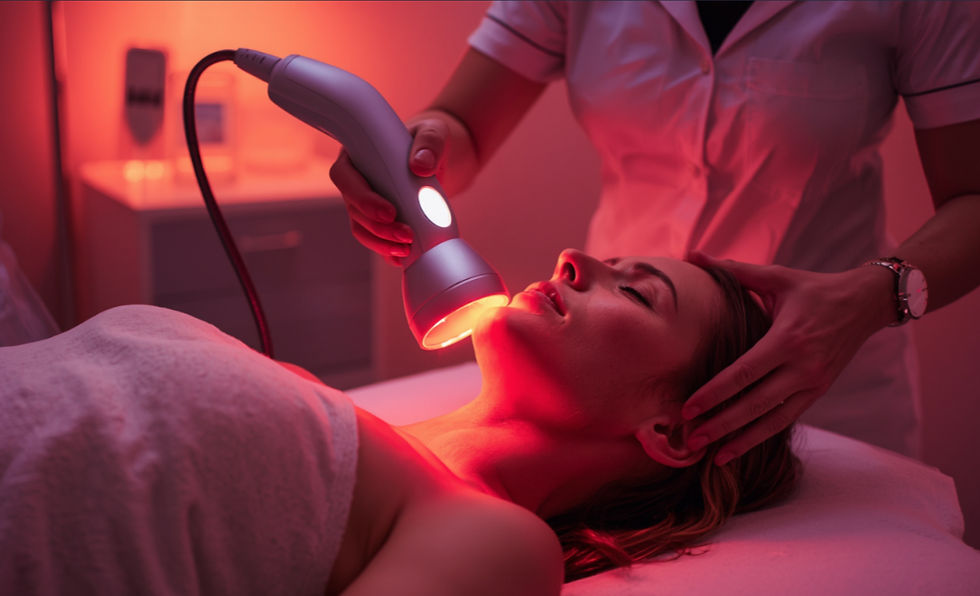
Photobiomodulation (PBM) works at a different level than PRP or shockwave, not on the tissue structure directly, but on the cellular energy system that drives every aspect of repair.
Medical grade laser light at specific red and near infrared wavelengths penetrates tissue and is absorbed by Cytochrome C Oxidase (Complex IV), the terminal enzyme of the mitochondrial electron transport chain. This absorption breaks an inhibitory nitric oxide, copper bond, rescuing Complex IV function and triggering a surge in ATP production, the cellular currency of energy.
From that ATP surge, a cascade follows: nitric oxide release drives local vasodilation and increased blood flow; reactive oxygen species (ROS) at controlled levels activate the ERK/MAPK repair pathway; anti-inflammatory cytokine profiles shift; VEGF rises; fibroblasts activate; collagen synthesis begins.
The research on PBM as an adjunct to PRP is particularly compelling. Multiple studies have demonstrated that PBM applied in the days and weeks following PRP injection significantly enhances growth factor uptake and tissue response, essentially amplifying the therapeutic signal from the injected platelets. The combination isn't additive; it's synergistic.
The Multimodal Approach: Why Combination Wins
The most important concept in regenerative medicine isn't any single treatment, it's the understanding that these modalities work on different parts of the same system, and that the clinical outcomes from intelligent combination protocols consistently exceed what any single treatment achieves alone.
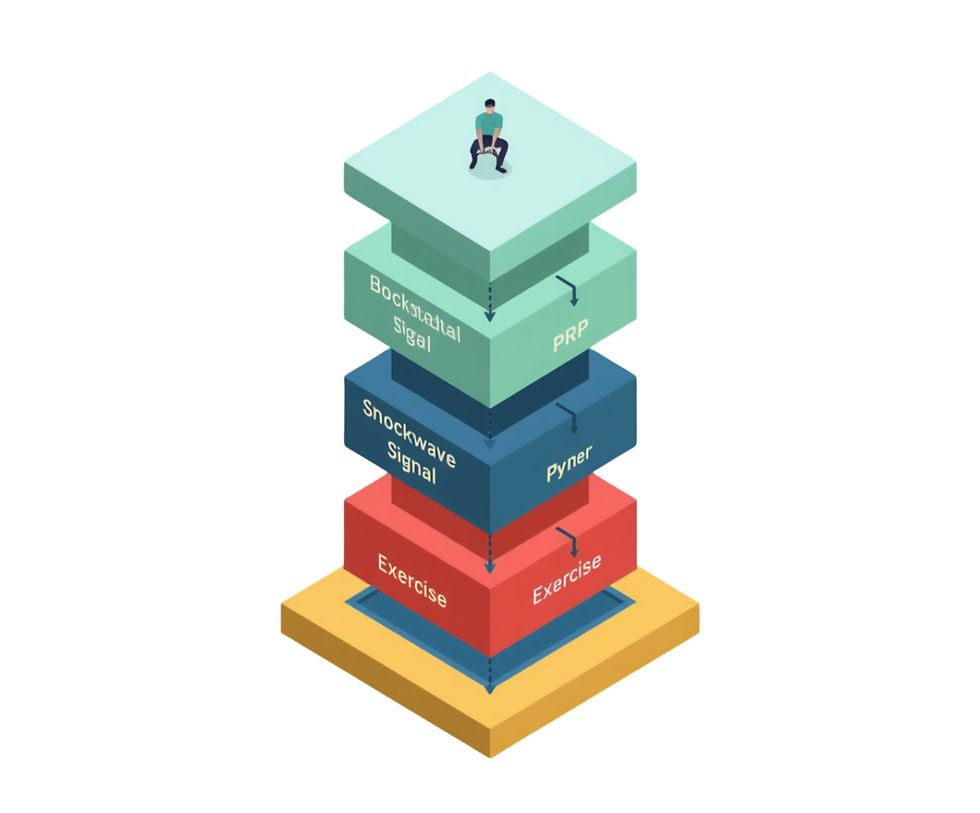
At AVION, we think about regenerative care as a layered protocol:
Layer 1: The Substrate: PRP or BMAC provides the raw biological material, the growth factors and regenerative cells the tissue needs but isn't generating sufficiently on its own.
Layer 2: The Signal: Shockwave activates the mechanotransduction pathways and creates the vascular and cellular environment that makes the injected material viable and effective.
Layer 3: The Power: PBM ensures the cells have the ATP they need to carry out the energy-intensive work of tissue repair, collagen synthesis, cell migration, angiogenesis, and maintains an anti-inflammatory environment that doesn't suppress the repair process.
Layer 4: The Load: Progressive physical rehabilitation is the essential final layer. Tissue remodels in response to load, the orientation of new collagen fibers, the strength of new bone, the functional capacity of repaired tendon, is determined by how that tissue is mechanically stressed during the remodeling window. Regenerative medicine without structured rehabilitation is like planting seeds without watering them.
The Regenerative Rehab program at AVION is built to integrate all four layers, coordinated with your injection provider if you're post-PRP or post-stem cell, or as a standalone program if shockwave and PBM are driving your recovery.
Who Is Regenerative Medicine For?
You don't need to be a professional athlete or have a catastrophic injury to benefit from regenerative medicine. The patients who do best are those who:
Have a chronic musculoskeletal injury that hasn't fully resolved with rest, physical therapy, or cortisone
Are post-PRP or post-stem cell injection and need a structured rehabilitation environment that maximizes their investment
Are trying to avoid surgery and want to explore whether the tissue can heal given the right biological support
Have tendinopathy, plantar fasciitis, osteoarthritis, rotator cuff pathology, or other structural issues in joints and connective tissue
Want to recover faster from acute injuries, particularly in tendons and ligaments that are known for slow healing due to poor blood supply
The Regenerative Rehab program at AVION requires no physician evaluation to start. It's specifically designed as the entry point for post-injection patients, and as a standalone pathway for those with chronic soft tissue conditions who want to access shockwave, PBM, and structured loading in a single coordinated plan.
What to Expect at AVION
Your first step is a discovery call, a brief conversation to understand where you are, what you've tried, and whether our approach is the right fit. If it is, your plan is built around your specific pathology, your timeline, and your goals.
Regenerative Rehab sessions at AVION typically integrate:
Focused shockwave targeted at the specific tendon, joint, or tissue region, 2,000–3,000 pulses per session at titrated energy
Photobiomodulation applied to the treatment area to optimize the cellular environment before and after shockwave using 660-900 nm wavelengths
Progressive loading exercises prescribed and supervised by your clinician, designed to drive appropriate tissue remodeling throughout the plan
Sessions run weekly for the first phase, the spacing is intentional, allowing each shockwave treatment to complete its repair cascade before the next session initiates a new one. Most patients notice meaningful improvement in pain and function within the first 2-3 weeks, with continued structural gains over 8–12 weeks following the final session.
Frequently Asked Questions
Is this covered by insurance?
Shockwave and PBM are typically not covered by insurance as standalone treatments. AVION's package pricing is structured to make these therapies accessible without navigating insurance complexity, with all packages available in two equal payment installments.
Do I need a physician referral?
No. The Regenerative Rehab program at AVION is direct-access, you can book without a referral or prior evaluation.
Can I do this if I haven't had an injection?
Yes. Shockwave and PBM are effective regenerative treatments independent of PRP or stem cell injections. Many patients complete a full regenerative rehab plan without any injections and achieve substantial recovery.
How is this different from regular physical therapy?
Traditional PT primarily uses exercise, manual therapy, and modalities to improve function and reduce pain. Regenerative rehab goes a step further, using shockwave and PBM to directly address the tissue pathology driving the problem, creating the biological conditions that allow exercise-based rehabilitation to actually work. For patients who have plateaued with traditional PT, this is often the missing piece.
The Future of Healing Is Already Here
Regenerative medicine isn't experimental. It's not a fringe approach. It is a well researched, evidence supported clinical framework that reflects our growing understanding of how the body actually heals and what it needs when it gets stuck.
At AVION Sports Rehab, located in Fort Lauderdale, we've built our practice around this framework. Not because it's new and interesting, but because it consistently produces outcomes that traditional approaches can't match for the right patient population.
If you've been managing an injury rather than resolving it, it's worth having a conversation about whether regenerative medicine might be the shift you need.
👉 Schedule a Free Discovery Call we'll talk through your history, your goals, and whether our Regenerative Rehab program is the right fit.
👉 Book Your First Session and start working with the biology, not around it.
AVION Sports Rehab Fort Lauderdale, FL | 954-902-5150
References
Kou L, et al. Application of extracorporeal shock wave therapy in the field of orthopedics and sports medicine. Front Bioeng Biotechnol. 2024.
Dhurat R, Sukesh M. Principles and methods of preparation of platelet-rich plasma: A review and author's perspective. J Cutan Aesthet Surg. 2014;7(4):189–197.
Caplan AI. Mesenchymal stem cells: Time to change the name. Stem Cells Translational Medicine. 2017;6(6):1445–1451.
Hamblin MR. Mechanisms and mitochondrial redox signaling in photobiomodulation. Photochem Photobiol. 2018;94(2):199–212.
Guo et al. The effect of extracorporeal shockwave therapy in tendinopathy: A systematic review and network meta-analysis (3,921 patients). 2025.
Vetrano M, et al. Extracorporeal shock wave therapy promotes cell proliferation and collagen synthesis of primary cultured human tenocytes. Knee Surg Sports Traumatol Arthrosc. 2011;19(12):2159–2168.

Comments